Geiger counter: What is it for and how does it work

The Geiger Counter: Definition and operating principle

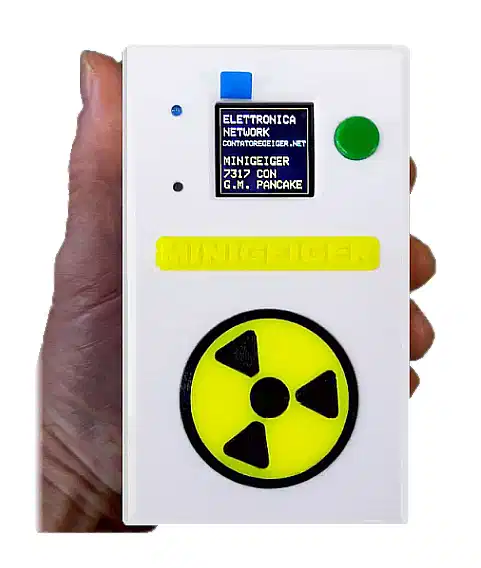
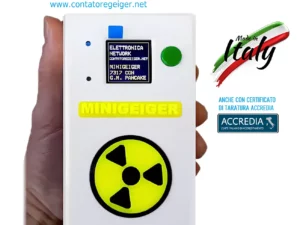
Geiger counter made in Italy MINIGEIGER 7317 with Geiger probe Muller Pancake White

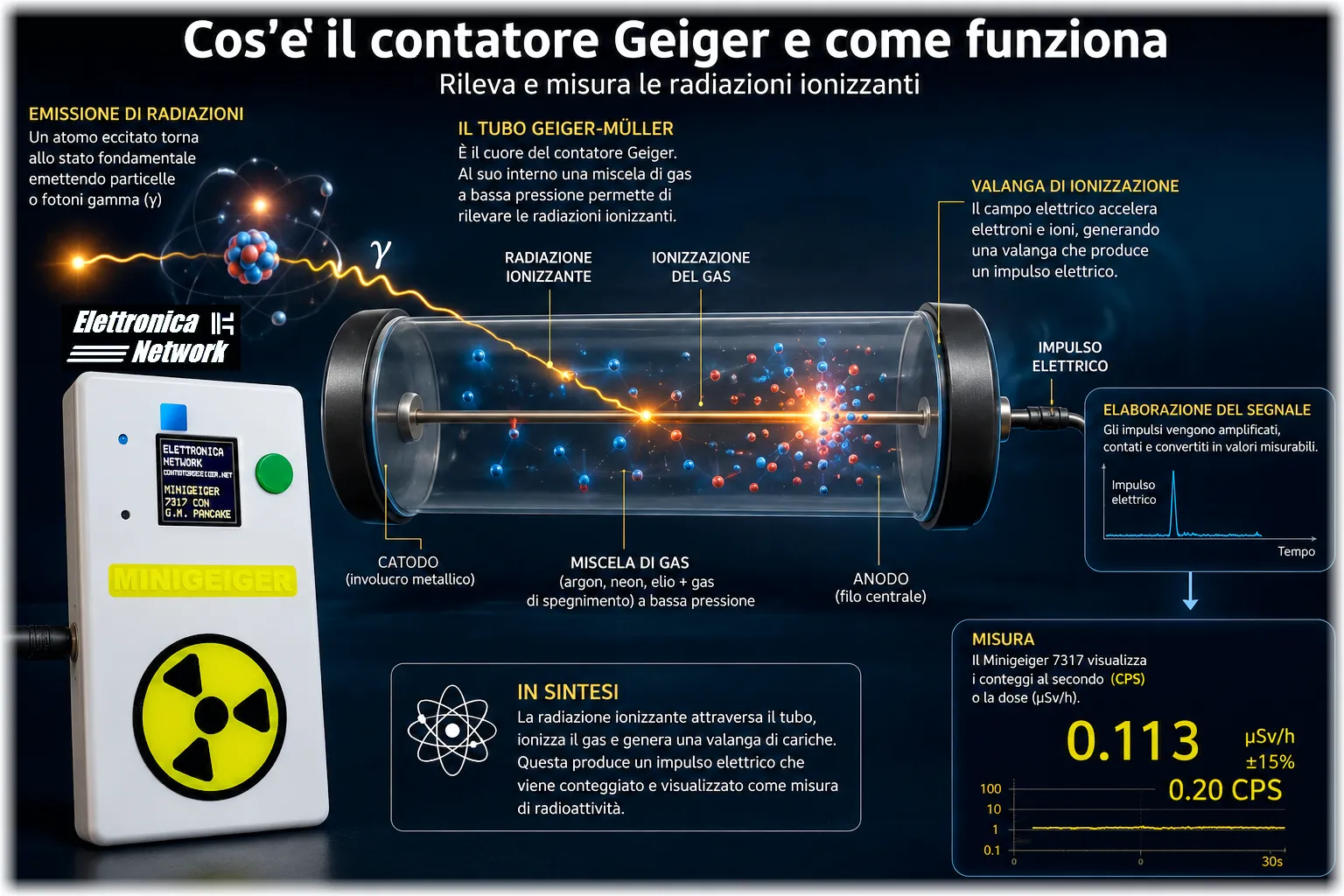
The Geiger Counter is an instrument for measuring and controlling ionizing radiation that works on the principle of the ion drift Geiger-Müller tube..

Sneeded to detect and measure the presence of ionizing radiation (Alpha particles, Beta, Gamma and X -rays) in the environment, in building materials, in foods, in scrap or industrial waste.

It is considered the essential tool in many areas where it is necessary to detect the presence of ionizing radiation:

  • Healthcare and Radiation Protection: Used in hospitals, nuclear medicine departments, radiology and research centers to monitor the safety of working environments and healthcare personnel.

  • Industry and Scrap Metal: Indispensable in foundries, recycling plants, waste management and customs controls to verify the absence of contamination on scrap and raw materials.

  • Construction and Materials Control: Used for testing building materials (granites, spit, pozzolana, ceramics) and fuels such as imported wood pellets.

  • Environmental Monitoring: Used by conservation bodies (such as ARPA and Fire Brigade) or by private individuals to detect the natural radioactivity background on land, air and waterways.

  • Teaching and Collecting: Adopted in schools and universities for physics experiments, and by enthusiasts to verify the activity of minerals (uraninite) or old vintage objects painted in Radium.

Its functioning it is based on a physical principle perfected in 1928 by Hans Geiger and Walther Müller: the ionization of the noble gas inside the tube and the subsequent ionic drift of the charges under the effect of a strong electric field.

Types of Geiger Tubes and the Advantage of the Pancake Probe

Thanks to continuous advances in technology, modern geiger counters employ different types of tubi Geiger-Müller. Even though they are all based on the same physical principle, these sensors differ profoundly in shape, dimensions, intrinsic sensitivity and ability to detect specific types of radiation.

An example of excellence is represented by the Geiger-Müller probe for pancakes: characterized by a circular shape and a large window not ultra-thin, they allow not only gamma rays to be detected with very high sensitivity, but also particles Alfa and radiation Low energy beta.

Although the detectors on the market have levels of efficiency, very different accuracy and costs, their primary function remains the same: count the number of radioactive particles that pass through the probe in a given period of time.

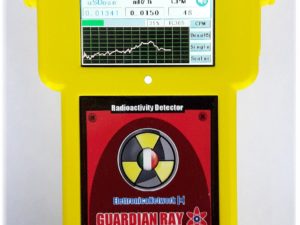
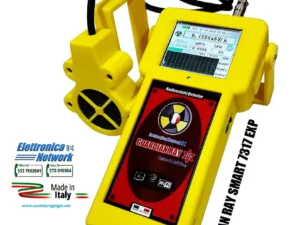
About this, our Geiger Counters Guardian Ray Smart 7317Minigeiger 7317 they only use high performance Pancake probes, capable of measuring every type of ionizing radiation with maximum precision.

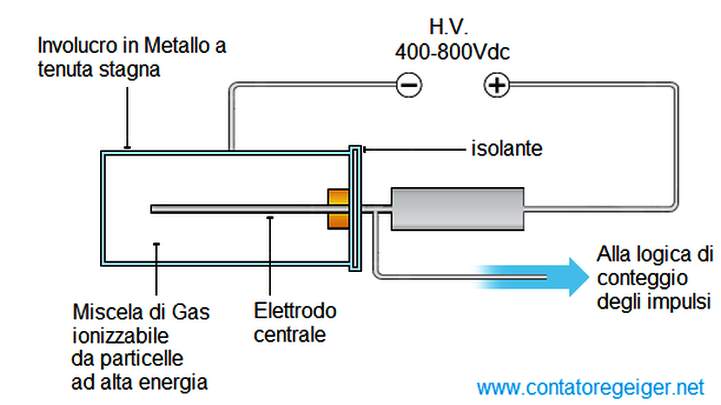
The Geiger tube works like an ion drift chamber.

tubo contatore geiger muller

“The Geiger Counter uses the Geiger-Müller tube as a Ion drift chamber. By applying a high working voltage to the internal gas, the instrument is set up in a pre-electrical discharge state.

The working voltage is intentionally set to a high value (in the so-called Geiger region), but slightly lower than the value that would cause continuous spontaneous ionization of the gas.

In this way, ideal conditions are created so that the response of the instrument does not depend on the energy of the single particle, but from the actual count of the radioactive event.

Consequentially, the strong electric field inside the tube accelerates the primary charges created by the passage of radiation, triggering an avalanche effect of secondary charges.

summing up, when a radioactive particle passes through the gas, triggers a very specific physical reaction:

  • Acceleration of Charges: The strong electric field accelerates the primary electrons, causing an impressive series of secondary ionizations.

  • Avalanche multiplication: This physical phenomenon transforms the gas from a perfect insulator to an electrical conductor for an instant.

  • Impulse Generation: The rapid change in conductivity produces a clear electrical impulse (independent of the original energy of the particle), which is converted by the microcontroller into numerical counts.”

Operation principle of the Geiger Muller tube

By applying a high electrical voltage between the electrodes of the probe, the internal gaseous mixture is brought into a state of strong polarization, remaining just below the critical value that would trigger an electric discharge self-sustaining.

In this configuration, the gas contained in the Geiger tube becomes an electrical conductor only for very brief moments, that is, at the exact moment in which the ionizing radiation passes through it.

In the end, to prevent the electric discharge from becoming continuous, the noble gas is enriched with halogen gases or alcoholic vapors. These agents of quenching they extinguish the discharge in a fraction of a second, restoring the insulation state of the tube to allow it to record the next pulse.

The Polarization Voltage of the Geiger-Müller Tube

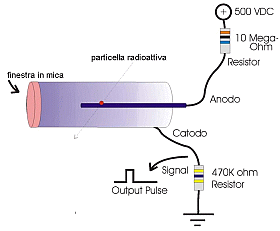
The bias voltage is not applied directly to the Geiger tube: A resistor with a high ohmic value is inserted in series with the power supply, in the order of several Megaohm (MΩ). This resistor helps extinguish the electrical discharge in the gas whenever an ionizing particle is detected.

Inside the Geiger-Müller tube there are two electrodes: il cathode (connected to the negative pole and coinciding with the external metal wall) and l’anode (a central thread, electrically isolated and polarized with a positive direct voltage between 400V e 800V).

The voltage value needed to position the instrument in the optimal measurement region — called Geiger plateau — depends both on the geometry of the probe and on the physical properties of the gaseous mixture. This working voltage must remain just below the critical level that would trigger a continuous electrical discharge due to the avalanche effect.

Therefore the electric field thus generated inside the detection device looks like this “pronto” to trigger an avalanche of electric current as soon as even a single pair of ions forms in the gas due to the radiation hitting it.

How the Electric Pulse is Generated in the Geiger Tube

Every time a radioactive particle passes through and ionizes the gas inside the Geiger-Müller tube, an electric microdischarge is triggered for a few microseconds which causes current to flow between the electrodes.

Due to the effect of the voltage drop on the resistor inserted in series with the circuit, a is generated at the tube terminals negative electrical impulse with a width of approximately 5–10 Volt and a duration of 50–100 microsecondi.

The primary ionization produced by the particle adds to the strong electric field already present in the tube, triggering an avalanche.

A fundamental aspect of the functioning of the Geiger tube is that the resulting electrical impulse is completely independent of the energy of the incident particle and by the original number of ion-electron pairs created.

In other words, whether it is a highly energetic Alpha particle or a Gamma ray, the tube generates a pulse of constant amplitude: the instrument then measures the number of radioactive events, and not their energy.

The best Geiger counters made in Italy - Italian excellence