


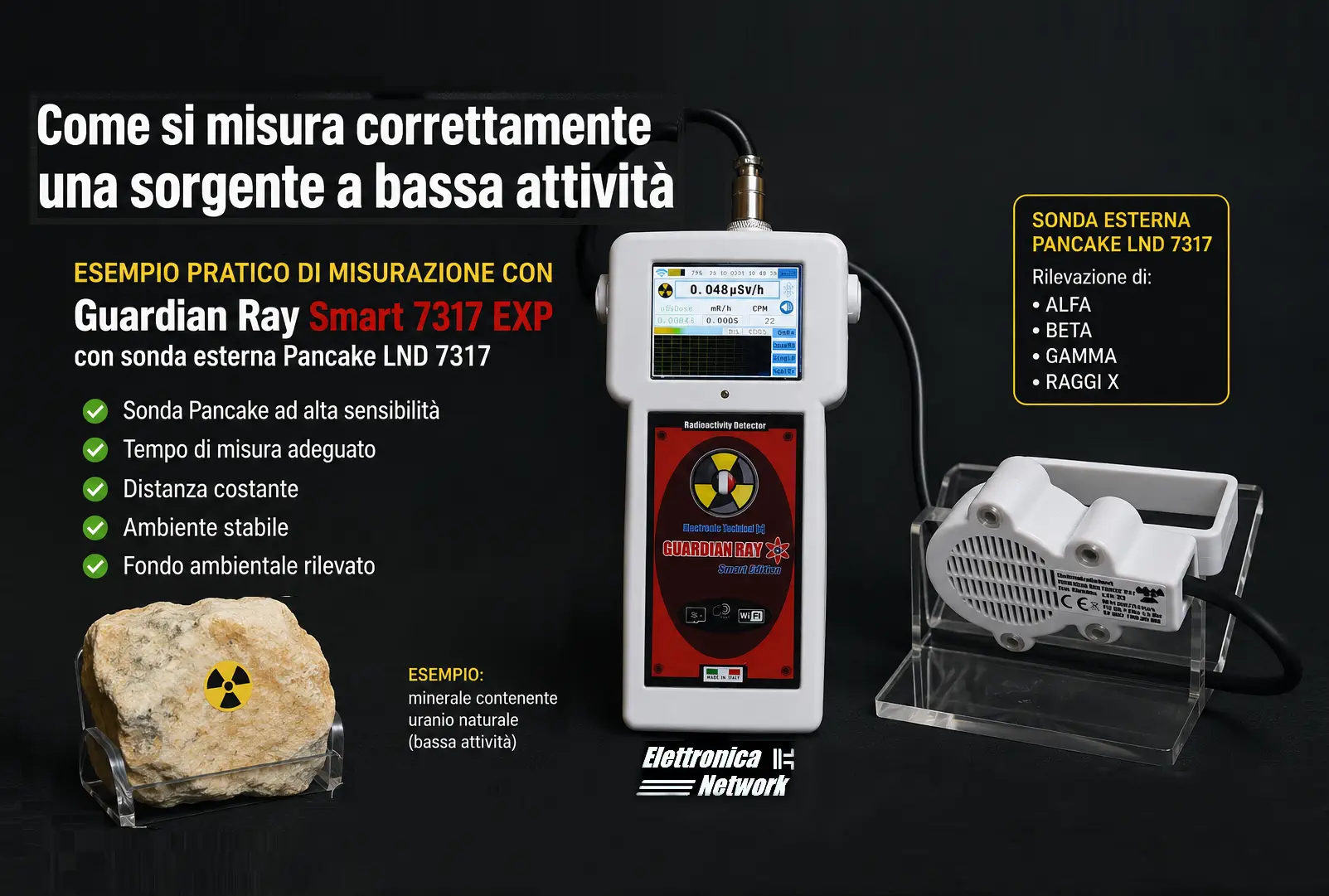
How to correctly measure a low activity radioactive source with a Geiger Counter. Measures, methodology and necessary tools.
Measuring a low activity radioactive source with a Geiger Counter represents one of the most interesting challenges for any enthusiast or professional in the sector. Under these conditions, Indeed, the number of Gamma particles or photons intercepted by the detector can be very small, making the measurement particularly sensitive to normal statistical fluctuations.
Measures, methodology and tools necessary to obtain reliable measurements
An inexperienced user could interpret these oscillations as a malfunction of the instrument, but in physical reality this is completely normal behavior. To obtain reliable data it is not enough to turn on the Geiger Counter and read the value shown on the display: it is necessary to adopt a correct measurement methodology and understand the probabilistic nature of radioactive decay.
Because Geiger Counter measurements fluctuate continuously?
Nuclear physics teaches us that radioactive decay is a random phenomenon. The atoms of a radioactive substance do not decay at regular intervals, but they follow a statistical distribution known as the Poisson distribution.
Consequentially, even keeping the Geiger Counter perfectly still and in the same measurement conditions, the number of counts detected will vary continuously.
For example, During a 60-second measurement you might record 30 counts, while in the following minute the counts could be 42. This variability does not represent a defect of the instrument, but the natural consequence of the randomness of radioactive decay.
Understanding this phenomenon is the first step to correctly interpret any radiometric measurement.
The role of acquisition time and statistical error
When weakly radioactive sources must be measured, Acquisition time is of fundamental importance.
In fact, the statistical error of a measurement decreases as the total number of pulses counted increases. In other words, the greater the number of events accumulated, the more reliable the final result will be.
Practical example
- 100 counts → statistical error approximately ±10%
- 1.000 counts → statistical error approximately ±3%
For this reason, in the most critical measurements it is advisable to use the function SCALER o Total Counts, present in professional Geiger counters, by setting long acquisition times, for example:
- 300 seconds;
- 600 seconds;
- 3600 seconds.
Only by accumulating a large number of events is it possible to reduce statistical uncertainty and obtain truly significant results.
Performing multiple consecutive measurements increases reliability
Relying on a single measure can be misleading.
Normal statistical fluctuations can in fact produce values occasionally higher or lower than the average. For this reason, in the most important measurements it is good practice to carry out at least three consecutive acquisitions with the same integration time.
Calculating the average of the values obtained and evaluating any clearly anomalous results, a more robust data is obtained which is more representative of the real activity of the source.
This procedure is also commonly used in the metrology field.
Keep the measurement geometry unchanged
To correctly compare measurements taken at different times it is essential to keep the measurement geometry constant.
It is therefore important to conserve:
- the same distance between source and probe;
- the same orientation as the detector;
- the same exposed surface;
- the same operating conditions.
In the case of point sources, especially for gamma radiation, the distance between probe and source can significantly influence the result.
Low-energy Beta radiation is even more critical, as they are easily absorbed from the air. Even small changes in distance can significantly change the number of particles detected.
Measure the natural background: the indispensable point of reference
The Geiger Counter always measures the sum of the radioactivity of the source and the natural environmental background.
The latter is mainly generated by:
- cosmic rays;
- Radon present in the air;
- building materials;
- natural radioactivity of the soil.
Before carrying out any measurement it is therefore advisable to detect the environmental background using the same acquisition time that will subsequently be used for the source.
For example:
- natural background: 25 CPM;
- source + bottom: 45 CPM;
The increase due exclusively to the source will therefore be equal to 20 CPM.
Without this operation, a low activity source could be difficult to distinguish from the natural background.
The advantage of high sensitivity probes
The choice of probe can significantly influence the quality of the measurement.
Traditional small Geiger tubes have a limited sensitive surface area and require longer acquisition times to obtain significant results.
Pancake type professional probes, like KJV 7317, instead have:
- large sensitive surface;
- thin mica window;
- high detection efficiency.
These characteristics make it possible to intercept a greater number of particles and to more effectively detect even low-energy Beta radiation that traditional Geiger tubes could measure with less sensitivity..
A higher number of counts also means lower statistical error and shorter measurement times.
CPM o µSv/h? Which unit to use?
For the evaluation of low activity sources it is generally preferable to use the values expressed in:
- CPM (Counts per Minute);
- CPS (Counts per Second).
The CPMs in fact represent the data actually measured by the detector.
The value expressed in µSv/h derives from a mathematical conversion carried out by the instrument software on the basis of specific calibration factors.
Since these coefficients can vary depending on the energy of the radiation and the type of isotope present, the CPM value is often the most objective and reliable parameter for comparing different sources.
Conclusions
Properly measuring a low-activity radioactive source requires patience, method and a good knowledge of the fundamental principles of radiometry.
The use of adequate acquisition times, the preventive measure of the natural background, the repetition of acquisitions and the use of highly sensitive probes allow precise and repeatable results to be obtained.
Even the best Geiger Counter cannot replace a correct measurement methodology.
For this reason, in measurements of weakly radioactive sources, patience and technique are often more important than the performance declared by the instrument used.